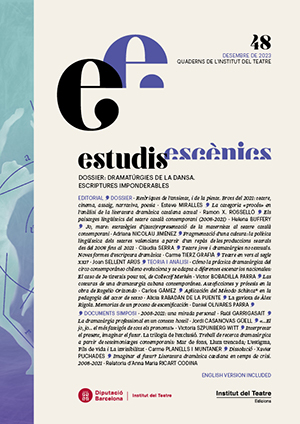

Tres textos de Maria Aurèlia Capmany
Tres textos de Maria Aurèlia Capmany
Capmany, Maria Aurèlia
(Re)coneguda per les diverses modulacions de la seva obra narrativa, Maria Aurèlia Capmany va erigir-se un clos particular en el teatre català dels anys seixanta. En un ambient absolutament impermeable al talent femení, Capmany sobresurt com a creadora i activista de l’Escola d’Art Dramàtic Adrià Gual (EADAG), juntament amb Ricard Salvat, amb qui es coneix, precisament, arran de l’estrena de Tu i l’hipòcrita (1959), a recer de les vetllades de l’ADB. Més que no pas de la pràctica com a narradora, la discursivitat del seu debut escènic ve marcada per les tendències boulevardières: concretament, de L’OEuf, de Felicien Marceau. En aquest sentit, un dels trets idiosincràtics de Capmany
seria, precisament, catalitzar al terrer autòcton diversos recursos i corrents en voga a l’escena europea. Del caràcter més aviat francòfil de Tu i l’hipòcrita, evolucionaria cap a les contextures èpiques. Vent de garbí i una mica de por (1965), de fet, serveix d’exemple de la pràctica de l’EADAG en el cinquè aniversari de la institució. La curiositat de l’autora, instigada pel director Josep Anton Codina, s’estendria cap a la pista de la Cova del Drac, on recrea les revistes alemanyes d’entreguerres amb el filtre coetani del cabaret italià de Paolo Poli. La primera mostra d’aquest gènere juganer, Dones, flors i pitança (1968), vehicula el tractament de temes socials més o menys polèmics i estereotipats, sense excessius apriorismes, per mitjà del dinamisme i el vertigen resultants de la mescla de pastitx literari, lirisme à la mode o sarau fregolià. L’obra teatral de Capmany no és pas prolífica, per bé que prou estimulant —cosa que es percep també en la peça breu Dos quarts de cinc (1963), en l’emblemàtic i clandestí Layret (1970) o en L’ombra de l’escorpí (1971)— perquè per a reivindicarla no sigui forçós d’apel·lar a la gènesi «femenina», sinó, fet i fet, al mèrit d’haver creat un univers particular i innovador, ben diferent de la resta de cales del teatre català de postguerra.
Conté: Tu i l’hipòcrita : comèdia predicada,en dos actes (1929) P37: D20, H17 ; Vent de garbí i una mica de por (1968) P14: D7, H7 ; Dones, flors i pitança (1968) P4: D2, H2; Inclou referències bibliogràfiques, pàgina 27; DL B 2448-2024
Capmany, Maria Aurèlia
(Re)coneguda per les diverses modulacions de la seva obra narrativa, Maria Aurèlia Capmany va erigir-se un clos particular en el teatre català dels anys seixanta. En un ambient absolutament impermeable al talent femení, Capmany sobresurt com a creadora i activista de l’Escola d’Art Dramàtic Adrià Gual (EADAG), juntament amb Ricard Salvat, amb qui es coneix, precisament, arran de l’estrena de Tu i l’hipòcrita (1959), a recer de les vetllades de l’ADB. Més que no pas de la pràctica com a narradora, la discursivitat del seu debut escènic ve marcada per les tendències boulevardières: concretament, de L’OEuf, de Felicien Marceau. En aquest sentit, un dels trets idiosincràtics de Capmany
seria, precisament, catalitzar al terrer autòcton diversos recursos i corrents en voga a l’escena europea. Del caràcter més aviat francòfil de Tu i l’hipòcrita, evolucionaria cap a les contextures èpiques. Vent de garbí i una mica de por (1965), de fet, serveix d’exemple de la pràctica de l’EADAG en el cinquè aniversari de la institució. La curiositat de l’autora, instigada pel director Josep Anton Codina, s’estendria cap a la pista de la Cova del Drac, on recrea les revistes alemanyes d’entreguerres amb el filtre coetani del cabaret italià de Paolo Poli. La primera mostra d’aquest gènere juganer, Dones, flors i pitança (1968), vehicula el tractament de temes socials més o menys polèmics i estereotipats, sense excessius apriorismes, per mitjà del dinamisme i el vertigen resultants de la mescla de pastitx literari, lirisme à la mode o sarau fregolià. L’obra teatral de Capmany no és pas prolífica, per bé que prou estimulant —cosa que es percep també en la peça breu Dos quarts de cinc (1963), en l’emblemàtic i clandestí Layret (1970) o en L’ombra de l’escorpí (1971)— perquè per a reivindicarla no sigui forçós d’apel·lar a la gènesi «femenina», sinó, fet i fet, al mèrit d’haver creat un univers particular i innovador, ben diferent de la resta de cales del teatre català de postguerra.
Conté: Tu i l’hipòcrita : comèdia predicada,en dos actes (1929) P37: D20, H17 ; Vent de garbí i una mica de por (1968) P14: D7, H7 ; Dones, flors i pitança (1968) P4: D2, H2; Inclou referències bibliogràfiques, pàgina 27; DL B 2448-2024